Build in Public Highlight: StayUp and the Half-Life of Attention
A founder's look at StayUp, a project directory that combines permanent backlinks, Domain Rating tracking, and rankings designed to keep moving.
Directories Have an Attention Problem
Submitting a product to a directory is one of those tasks that feels complete the moment it is done.
You write the description, add the URL, choose a category, and publish. For a day or two, the listing might sit near the top of a new-products page. A few visitors arrive. Then more projects are submitted, the page moves, and the listing slowly disappears into an archive.
The backlink may remain, but the attention usually does not.
That is not necessarily a flaw. Directories have to organize a growing catalog somehow. But it creates an awkward incentive: every founder wants durable discovery, while the directory depends on a constant flow of new activity. If the ranking never changes, early winners own the front page forever. If it changes only by submission date, every project gets a brief moment and then becomes invisible.
The interesting question is not simply how to rank projects.
It is how to let attention move without making participation feel temporary.
The Idea Behind StayUp
I recently came across StayUp, built by Sergey Atroshchenko, and the product caught my attention because it combines several small founder needs into one public object.
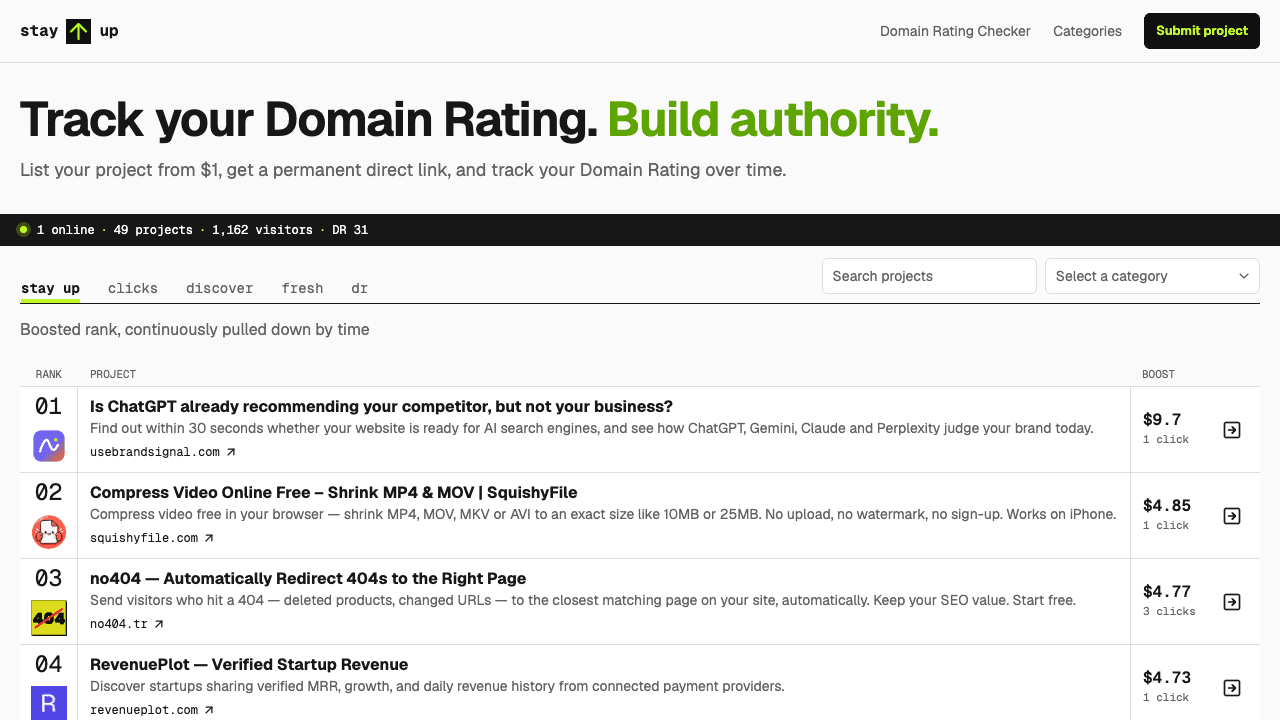
A project can be listed from $1. The listing includes a permanent project page, a direct link, daily Domain Rating observations, and an embeddable DR badge. The directory then gives the project several ways to be discovered: a main board driven by paid boosts, a clicks board driven by recent qualified attention, a discovery view, fresh listings, and a DR ranking.
I have not submitted a project or tested the checkout flow, so this is not a hands-on review. This highlight is based on StayUp's public pages and the mechanics the site explains. What interests me is the system behind the listing: permanent ownership on one side, temporary ranking power on the other.
That separation gives the product a clearer promise than “pay once and hope someone finds you.”
A Permanent Page With a Moving Position
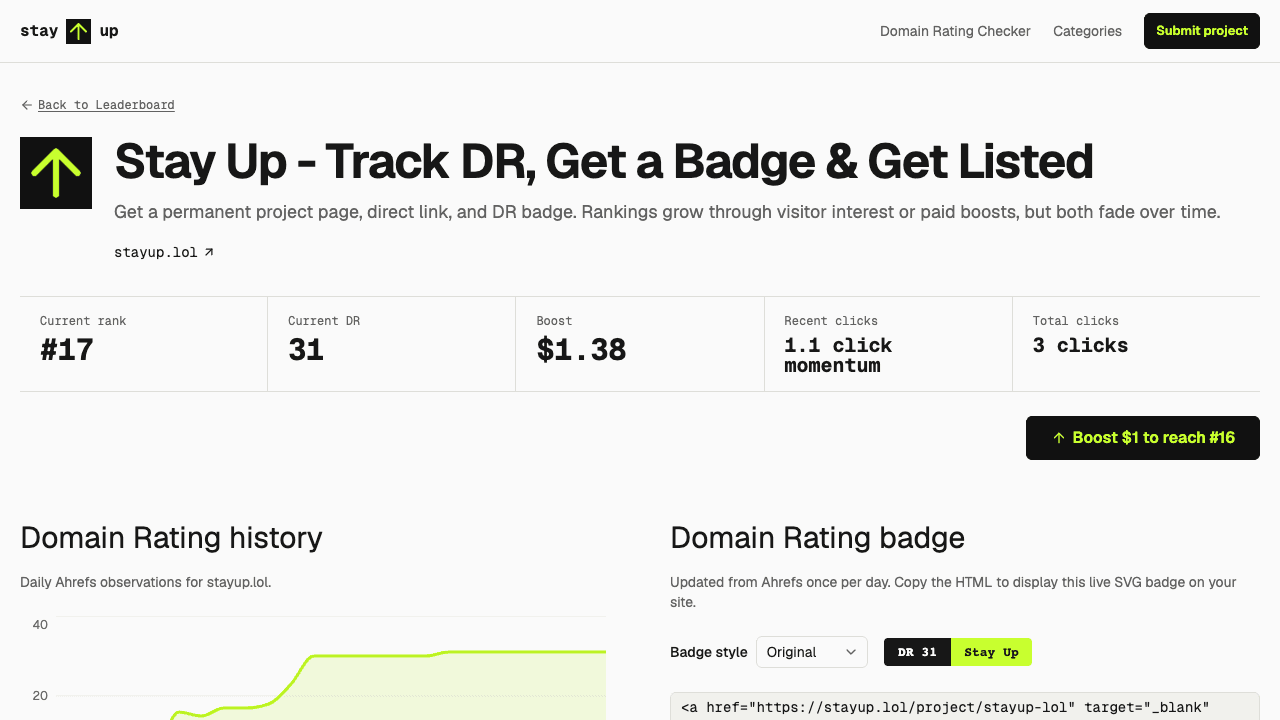
The most useful distinction in StayUp is that the project page and the leaderboard position are not the same thing.
The page is durable. It gives the product a stable URL, a description, a direct website link, its current Domain Rating, DR history, click totals, and a badge that can be displayed elsewhere. It can keep accumulating context after the first day.
The position is intentionally unstable.
That matters because a directory is really two products at once. For the founder, it is a place to establish another public reference to the project. For the visitor, it is a way to see what deserves attention now. A permanent page serves the first job; a changing leaderboard serves the second.
Trying to make one ranking do both jobs usually creates a stale list or a disposable listing. StayUp avoids that by giving permanence to the page while allowing visibility to keep moving.
Two Signals That Do Not Pretend to Be One
StayUp explains its ranking through two separate signals.
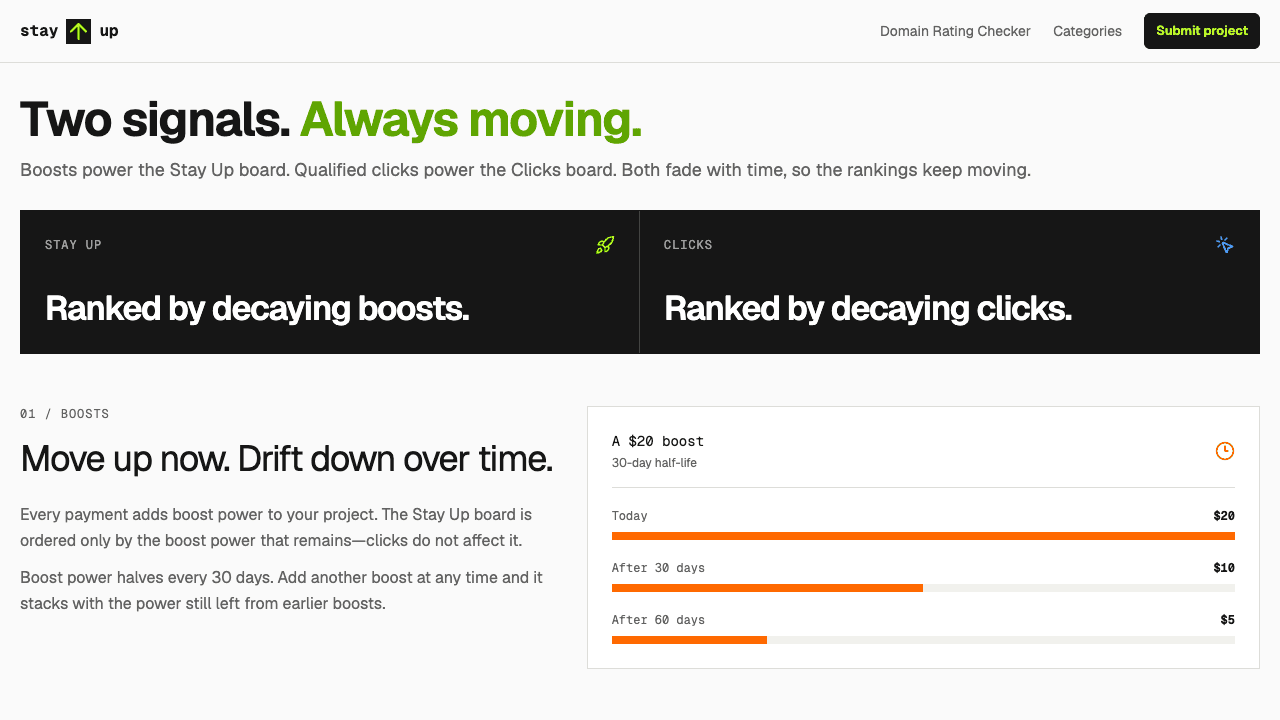
The main Stay Up board is ordered by paid boost power. A payment adds power immediately, then that power halves every 30 days. A later boost stacks with whatever remains from the earlier one.
The Clicks board is ordered by recent qualified clicks. Its momentum halves every 7 days. The public total remains visible, but older clicks gradually carry less ranking influence.
The part I like is not only the decay. It is the refusal to merge the two signals.
A boost does not become organic interest. A click does not secretly increase paid rank. One board shows who is paying for visibility now; the other shows where recent visitors are choosing to go. Both can be useful, but they mean different things.
That honesty is important in any marketplace or directory. A blended score can look objective while hiding the product's real economics. Separate boards make the tradeoff legible.
The product lesson: When two signals represent different kinds of value, showing them separately can create more trust than compressing them into one mysterious score.
Decay Keeps the Board Alive
Most leaderboards reward accumulation. The person with the biggest early lead keeps collecting visibility, which creates an even bigger lead. That can work for all-time records, but it is not always useful for discovery.
Decay changes the question from “who has won the most?” to “where is the energy right now?”
For boosts, that means a founder can buy visibility without buying the top of the site forever. For clicks, it means a project cannot hold its place indefinitely because of one old burst of traffic. Every position slowly becomes available again.
There is a nice product tension in that model. The founder gets something permanent from listing, but staying visible requires renewed attention, renewed spend, or both. The directory gets movement without having to erase old projects. Visitors get a board that has a reason to change between visits.
It also creates a more understandable form of urgency. The urgency is not a fake countdown or a launch window that disappears at midnight. It comes from a visible system: momentum has a half-life.
Domain Rating as a History, Not a Screenshot
The Domain Rating layer makes StayUp more than a bidding board.
Anyone can use the site to check a domain, while listed projects receive daily Ahrefs observations, a chart of their DR over time, and an SVG badge that reflects the current value. That changes Domain Rating from a number someone looks up occasionally into a small public history.
DR is still only one third-party metric. It is not traffic, revenue, rankings, product quality, or proof that a specific backlink caused anything. The site is more useful when that boundary stays clear.
But a history can be valuable even when a single observation is limited. It lets a founder notice movement, connect it to broader authority work, and keep the signal visible without repeating the lookup manually.
This connects directly to what I learned while building authority for my own site: the useful part is rarely one score on one day. It is the sequence of small actions—publishing, earning mentions, creating useful pages, and building relationships—that makes the direction of the graph meaningful.
The Page Is Also a Feedback Loop
A normal directory submission has a weak feedback loop. The founder sees that the listing exists, perhaps notices a referral in analytics, and then forgets about it.
StayUp brings more of the loop onto the public page:
- The rank shows current position.
- The boost shows paid momentum that remains.
- Recent clicks show current interest.
- Total clicks preserve the accumulated result.
- DR history shows a separate authority signal over time.
- The badge creates a path back from the founder's site to the listing.
None of those measurements proves that a listing created a customer. Still, they make the object feel alive. There is something to return to, compare, and understand.
That is a strong retention mechanism for a simple directory. The project does not need to become a complex analytics suite. It only needs to make the consequences of participating more visible than a static card would.
The Questions I Would Watch
The mechanics are clear, but the product will become more interesting as the catalog grows. These are the questions I would watch:
- Can qualification keep click rankings resistant to repeated or manufactured activity?
- Will category pages stay useful when hundreds or thousands of projects compete for attention?
- Can founders understand the difference between DR correlation and the effect of one directory backlink?
- Does the permanent listing keep receiving discovery after its paid boost has mostly decayed?
- Will visitors use the different boards as genuinely different discovery modes?
- Can the product preserve transparent paid placement as larger budgets enter the system?
These are not reasons the model cannot work. They are the tests created by its own strengths. A moving leaderboard becomes valuable when people trust why it moves.
What I Am Taking From StayUp
What I take from StayUp is the idea that permanence and freshness do not have to fight each other.
A founder can receive a durable page and backlink. A visitor can still see a changing surface. Paid visibility can be explicit. Organic attention can have its own board. Old activity can remain part of the record without controlling today's order.
It is also a reminder that small products can become more coherent by connecting adjacent needs. A directory listing, DR lookup, history chart, backlink, badge, and leaderboard could have been six disconnected tools. StayUp makes them different views of one project identity.
That kind of integration is useful for indie founders because distribution rarely fails from having no possible channels. It fails because each channel becomes another isolated task with no memory and no feedback.
StayUp gives the listing a memory, then lets the attention keep moving.
Resources and Links
- Official site: StayUp
- How the rankings work: Two signals, always moving
- Domain Rating checker: Check a site's DR
- Creator: Sergey Atroshchenko on X
- Related reading: SEO Basics Guide, Flowsery highlight, and Bloghandler highlight
Connect with me
Follow my journey building in public, sharing insights about development, and creating products.